
Reclaiming Our Common Ground: What We Must Do to Unite Our Country Again
To build a more united country, we must recognize that national unity does not require us to think exactly alike; rather, it requires us to trust each other enough to disagree without viewing our neighbors as enemies. In recent years, our shared spaces have transformed into battlegrounds of words and political identities. Many Americans feel that our social fabric is tearing apart, leaving us to wonder how—or if—we can ever patch it back together.
True unity will not come from one political side completely defeating the other. It will not happen by forcing everyone to agree on every single policy or social issue. Instead, reuniting our country requires a deliberate, step-by-step commitment to changing how we talk, how we consume information, how we structure our elections, and how we treat the people in our local communities. By focusing on practical, common-sense shifts, we can move away from deep hostility and lean back into our shared values.
Before we can fix our national house, we must understand why the foundation feels so unstable. Political division is not a new invention, but modern polarization is uniquely deep. Social scientists look at this through two primary lenses: ideological polarization (disagreeing on facts and policies) and affective polarization (simply disliking or fearing the other side) [1].
Today, the biggest threat to our unity is affective polarization.  We have moved from a place of saying, “I disagree with your tax plan,” to saying, “I believe you are a bad person because of who you voted for.” When political parties become tied to our core identities—like our religion, our race, our geography, or our cultural values—compromise starts to look like betrayal [1].
Our brains are naturally wired for group loyalty. In his groundbreaking research on moral psychology, social scientist Jonathan Haidt explains that human beings are fundamentally “groupish.” We love to join teams, wave flags, and protect our inner circle. While this trait helped our ancestors survive by working together in tribes, it creates massive challenges in a large, diverse, modern democracy. When political leaders and media outlets feed into this tribal instinct, they make us righteously certain that our side holds all the virtue and the other side holds all the malice. To break this cycle, we have to acknowledge our built-in biases and actively work against them.
If we want to change our country, we have to change our conversations. The language we use in daily life, both online and in person, has become incredibly sharp. We frequently use blanket labels to dismiss entire groups of people. To restore unity, we must practice the difficult art of listening to understand, rather than listening just to construct a counter-argument.
When someone expresses a political opinion that completely contradicts your worldview, the natural human reaction is defensiveness or anger. However, a united society requires us to trade anger for curiosity. Instead of asking, “How could anyone be so foolish?” we should ask, “What life experiences led this person to see the world this way?”
Practicing curiosity does not mean you have to change your mind or compromise your deeply held beliefs. It simply means recognizing that your political opponent is an individual with fears, hopes, and experiences just as real as your own. When we approach disagreements with a desire to learn rather than an urge to win, the temperature of the room drops immediately.
It is remarkably easy to say cruel things to a stranger behind a generic username on the internet. It is much harder to look a neighbor in the eye across a kitchen table or at a neighborhood barbecue and treat them with contempt.
One of the most effective paths to national unity is stepping away from national politics and stepping into local spaces. When we serve together on school boards, volunteer at local food banks, coach youth sports, or attend neighborhood clean-up days, our political labels begin to fade. We start to see each other as parents, coaches, and neighbors first, and as voters second.
We cannot have a united country if we cannot even agree on a basic set of facts. Today, Americans live in completely different information universes. The rise of social media algorithms and highly partisan cable news networks has created “echo chambers”—digital spaces where we only hear ideas that confirm what we already believe.

Social media platforms are businesses designed to keep your eyeballs on the screen for as long as possible. Computer programmers figured out long ago that nothing keeps a person clicking, scrolling, and sharing quite like moral outrage and fear. Therefore, algorithms are designed to feed you content that makes you angry at the “other side.”
If you lean left, your feed will be filled with the worst examples of behavior from people on the right. If you lean right, your feed will show you the most extreme, outrageous statements from people on the left. Over time, this constant diet of outrage distorts our view of reality. We begin to believe that the most extreme voices on the other side represent the average citizen, which is rarely true.
To heal this fracture, every individual must take personal responsibility for their digital diet. We must move from being passive consumers of information to active investigators. This means:
-
- Checking the source: Before sharing an outrageous story or headline, pause to see if it has been verified by multiple independent outlets.
- Seeking out opposing views: Actively read or listen to responsible commentators from across the political spectrum to understand the strongest version of their arguments, rather than the cartoonish versions shown by opponents.
- Limiting political screen time: Dedicate specific times of the week to unplug completely from national political news and reconnect with physical, real-world activities.
While personal behavioral changes are vital, we also have to face a hard reality: our current political system is perfectly designed to produce division. In many ways, politicians are rewarded for being divisive and punished for trying to compromise. To fix this, we must consider structural changes to our election systems.
In much of the United States, primary elections are “closed,” meaning only registered Democrats can vote in the Democratic primary, and only registered Republicans can vote in the Republican primary. Because voter turnout in primaries is typically very low, the citizens who show up to vote are often the most ideologically extreme and intensely partisan members of each party [4].
To win a primary election in this environment, a candidate must appeal to the fringes of their party. If a moderate politician tries to work across the aisle to pass a bipartisan bill, they are frequently accused of being a traitor and face a challenge from a more extreme candidate in the next election. This dynamic creates a “doom loop” where compromise is treated as a political death sentence [4].
Implementing Structural Solutions
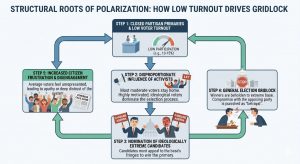 Many political scientists and grassroots organizations suggest that modifying our voting systems could naturally encourage moderation and unity. Two major ideas include:
-
- Open Primaries: Allowing all registered voters to participate in primary elections, regardless of party affiliation. This forces candidates to appeal to a broader, more moderate base of citizens from day one.
- Ranked-Choice Voting: A system where voters rank candidates in order of preference (first choice, second choice, third choice) rather than picking just one [4]. If no candidate wins a majority of first-place votes, the candidate in last place is eliminated, and their votes are redistributed to the voters’ second choices. This system encourages politicians to build broad coalitions and discourages negative campaigning, because a candidate cannot afford to alienate a rival’s supporters if they hope to be those voters’ second choice.
A country cannot stay together simply because of shared laws or geographic borders; it stays together because of a shared story. We must find a way to talk about our history and our national identity in a way that unites us rather than divides us.
In recent years, the debate over American history has become deeply polarized. One side often paints a picture of a nation that can do no wrong, ignoring the dark chapters of our past, such as slavery, the mistreatment of Native Americans, and systemic inequalities. The other side sometimes focuses so exclusively on these sins that they paint the country as fundamentally broken and irredeemable.
To unite, we must adopt a mature, honest view of our history—one that holds both pride and humility at the same time. We can celebrate the incredible breakthroughs of the American experiment, such as the creation of a system based on individual liberty, freedom of speech, and the rule of law, while openly acknowledging the times we failed to live up to those ideals. Our national story is not a finished masterpiece; it is an ongoing struggle to form a “more perfect union.”
We must reinvest in robust, non-partisan civic education for our children and communities. Unity grows when citizens deeply understand how our government works, why the checks and balances of the Constitution exist, and why protecting the rights of the minority is just as important as carrying out the will of the majority. When we understand the design of our system, we see that political friction is normal, but destroying our norms and institutions to win a short-term battle is incredibly dangerous.
Conclusion:
The Path Forward Starts with the Individual
Uniting our country again feels like an overwhelming, impossible task when we look at it on a national scale. We cannot force politicians to stop arguing on television, and we cannot instantly change the computer code that runs global social media platforms.
However, national unity is ultimately the sum of millions of tiny, individual decisions. The path forward begins when we reclaim control over our own behavior. It starts when we choose to pause before posting an angry comment online. It strengthens when we intentionally cross the street to welcome a neighbor who drives a car with a different political bumper sticker than our own. It deepens when we support local journalism that seeks truth over sensationalism.
We do not need to become a nation of identical thinkers. Our diversity of ideas, backgrounds, and beliefs has always been one of our greatest strengths. What we need is a renewed commitment to a simple, foundational American truth: we are all in this experiment together. By treating our neighbors with dignity, guarding our minds against manufactured outrage, and supporting common-sense system reforms, we can heal our fractures and ensure that our nation remains truly united.
Recommended Books on Amazon for Further Reading
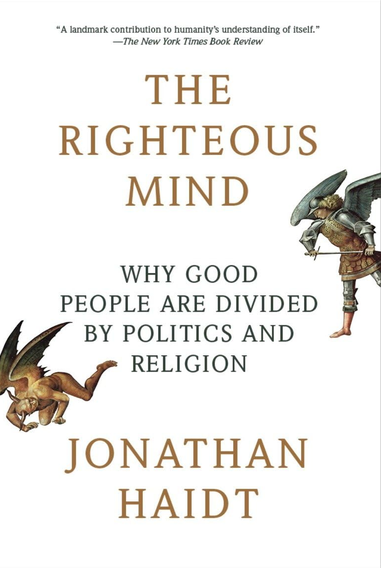
The Righteous Mind: Why Good People Are Divided by Politics and Religion by Jonathan Haidt: This landmark book explains the deep psychological reasons why well-meaning citizens view morality and politics in completely different ways. It provides a foundational guide for building empathy across deep cultural lines.
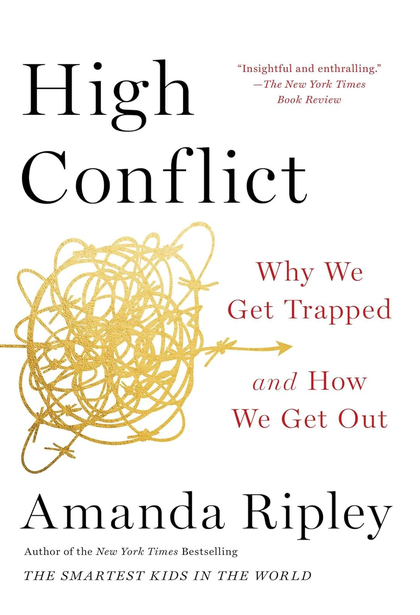
High Conflict: Why We Get Trapped and How We Get Out by Amanda Ripley: A brilliant examination of how normal disagreements turn into destructive, toxic feuds, and how individuals, communities, and nations can successfully break free from the trap of systemic outrage.
Disclaimer: As an Amazon Associate, I earn from qualifying purchases.
Footnotes and End-notes:
References Marked in Text
-
- [1] Grounded in the political science frameworks of affective and ideological polarization, notably detailed in Lilliana Mason’s research (Uncivil Agreement) exploring how social identities align perfectly with political parties to entrench cultural gridlock.
- Based on Moral Foundations Theory and social psychology research detailing human “groupishness” and instinctive tribal behaviors, as thoroughly outlined in modern behavioral texts like The Righteous Mind.
- Derived from sociological and tech-industry data regarding digital echo chambers and how modern algorithm loops maximize user engagement by amplifying social outrage and divisive content.
- [4] Based on electoral reform research and policy proposals advanced by democratic advocacy organizations such as Unite America, which analyze how low-turnout primary elections incentivize polarization and detail structural remedies like ranked-choice voting.
Endnotes
- Mason, Lilliana. Uncivil Agreement: How Politics Became Our Identity. University of Chicago Press. (Explores the psychological mechanisms behind why modern political arguments feel intensely personal and identity-driven).
- Haidt, Jonathan. The Righteous Mind: Why Good People Are Divided by Politics and Religion. Vintage Books. (An essential study on how different moral systems drive political alignment and how to overcome gut-level righteousness).
- Bail, Chris. Breaking the Social Media Prism: How to Make Our Platforms Less Polarizing. Princeton University Press. (Provides data-driven evidence on how online spaces distort our perceptions of the political opposition).
- Drutman, Lee. Breaking the Two-Party Doom Loop: The Case for Multiparty Democracy in America. Oxford University Press. (Details specific, practical structural electoral upgrades to encourage political moderation and compromise).
Be First to Comment